Webinar, Call for Papers, Collaborations, Resources
So Much Happening It Is Hard to Keep Up!

There is so much happening with the Institute for the Critical Study of Antizionism that it is getting hard to keep up!
This Issue: Webinar, Call for Papers, Collaborations, Resources
Please note the following updates and opportunities, and spread the word as we grow this movement!
(1) Webinar Series
The first lecture in ICSA’s inaugural six-part series, “Antizionism: History of an Ideology,” will occur this weekend! The series features six prominent scholars laying out the basic history, evolution, and contemporary manifestations of antizionism as an ideology, a worldview, and a movement. It is generously sponsored by Chai Mitzvah Scholars Circle.
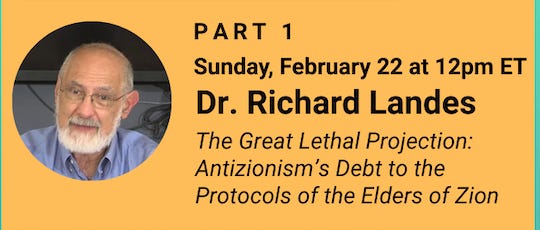
Sunday, Feb. 22, 12-1 PM Eastern
Prof. Richard Landes
“The Great Lethal Projection: Antizionism’s
Debt to the Protocols of the Elders of Zion”
Register here.
Those who pre-register will have access to a recording afterward if they cannot make it live.
Please join us, and spread the word!
(2) Calls for Papers, Galore!
(a) Please consider ICSA your first stop for all your antizionism-related scholarship. This substack (2500+ subscribers and rapidly growing) is a vehicle to disseminate your work to an interested audience who may want to use it, build on it, collaborate, etc. Publishing it here first, perhaps in a draft form, could be a good first step toward publication in a proper journal.
(b) Please share news of your antizionism-related scholarship here as well, including info about publications, conferences, etc. We will periodically include announcements about all such scholarship.
(c) Conference: The Association for the Study of the Middle East and Africa (ASMEA) has graciously agreed to provide ICSA some slots for ICSA-related papers and/or a panel at their upcoming conference on November 7 - 9, 2026, in Washington, D.C. To submit a proposal for an ICSA paper or a panel, please both (1) follow ASMEA’s submission procedure AND (2) message me separately that you are doing so. (They ask for an “approximately one-page proposal.”) To submit the proposal: visit this link, create a free account, and follow the prompts: https://www.asmeascholars.org/call-for-papers-2026. ASMEA’s deadline is May 15, 2026. Please let me know by May 1, 2026 if you plan to submit a proposal and/or let me know once you have done so.
ICSA solicits suggestions for ICSA-related themes for a panel. Three sample such themes might include “Antizionism’s Capture of Entire Disciplines,” “Antizionism’s Major Ideologues” (with individual papers providing critiques of the scholarship of different leading antizionist scholars, or perhaps three papers doing a deep dive into a single scholar), or “Jewish Antizionism.”
Though the details are not yet confirmed, ICSA expects to be able to pay $1000 to each individual whose work is presented under ICSA’s banner.
(d) Journal: ICSA intends to produce the inaugural edition of its journal, Critical Studies of Antizionism, by early fall of 2026. We are creating an editorial board and will institute a peer-review process. The theme will be “Antizionism in Focus” (or perhaps “Antizionism Exposed”). We initially seek papers in three categories in particular.
(i) Deep critical dives into those academic disciplines most thoroughly captured by antizionism (Middle East Studies, Anthropology, Sociology, Women’s studies, LGBT, etc). We would like to understand how that capture occurred, the non-academic mechanisms (such as social pressure, and rule-breakings) involved, the ideological aspects that produce such counterintuitive phenomena as “Queers for Palestine,” etc. The goal is not merely to critique but to expose: to show that such capture is not only academically unsound but driven by and producing deeper darker things that should have no place in a university environment.
(ii) Deep critical dives into leading antizionist scholars. We would like papers that don’t merely critique a Rashid Khalidi or Ilan Pappé or Peter Beinart (for example) but expose them: as “unconvincing and hollow” and/or as “repudiating moral and spiritual values,” as well as repudiating academic values by engaging in such dishonest “tricks of the trade” as selective quotation, deliberate omissions of context, circular reasoning (that begins with a hateful presumption about Israel or the Jews then cherry-picks evidence to support it), etc.
(iii) Jewish antizionism. Empirical work about (e.g.) the factors that lead individual Jews into antizionism, as well as about how the broader Jewish community should address the problem. Theoretical work critiquing or exposing the ideology developed by Jewish antizionist scholars (such as “diasporism”), or examining the role the presence of such individuals plays in “Jew-washing” the potential antisemitism of antizionism, etc.
Papers for the journal should be 2000-3000 words. Deadline for submissions is June 15, 2026, but please let us know as soon as you do whether you plan to submit something.
Though the details are not yet confirmed, ICSA expects to be able to pay $1000 to each person whose paper is accepted. Note: the same work could both be presented at the ASMEA conference and appear in the journal, thus earning double compensation.
(3) Collaborations? Seeking Collaborators:
(a) To create a digital archive of major sources and resources of antizionist scholarship then analysis thereof. What are the most important primary and secondary sources of scholarship that supports or advances antizionism, historical and contemporary?
Ultimately this archive might be featured on ICSA’s website, or as a self-standing website, but is then foundational to the next part of the project: to use this digitized archive to analyze how antizionist doctrines began, developed, morphed, and spread, including the key libels of colonialism, racism-apartheid, and genocide. We must identify and isolate their “tricks of the trade,” such as selective quotation, omission of context, counterevidence, and alternative points of view, the assumption of pure Israeli-Jewish agency and Palestinian passivity, the role that preexisting assumptions about Jewish malevolence play in interpreting events in the ongoing conflict, etc. Once digitized the archive will become available to AI-driven analysis, by those competent to do that work.
(b) Create curricula: A member writes, “I am interested in helping to create a curriculum for educating on this to people who are not as invested. I’ve developed curricula for classes and also feel that I have some insight into what is and what isn’t effective, and what is missing in currently available programs. I think there are at least 2 different courses that could be developed: One would be aimed at Jewish institutions to help them understand how things have changed, and what needs to be addressed in their own work. The other would be aimed at general populations as maybe something like a CE (cont ed) course that would fulfill professional ed requirements.”
(4) Resources
The anonymous blogger Elder of Ziyon does some impressive scholarly work, and is worth a follow.
What Antisemitism Studies Can Learn From Racism Studies — And Vice Versa
by Elder of Ziyon
Magda Teter, a historian at Fordham University and author of Christian Supremacy and the National Jewish Book Award-winning Blood Libel, was just named the inaugural Scholar-in-Residence at the Yale Program for the Study of Antisemitism. Her first public lecture, titled “On Jewish Suffering, Empathy, and the Need to Rethink Antisemitism,” took place this week.
Based on what we know from the Yale Daily News and Yale’s own announcement, Teter wants to move the field beyond the exhausting definitional debates — IHRA vs. Jerusalem Declaration, is criticism of Israel antisemitism, and so on — and toward something more fundamental.
Based on her earlier lectures and her book Christian Supremacy, we can see what she has in mind.
Teter draws a sharp contrast between how antisemitism and racism are studied academically:
Antisemitism studies tends to focus on perpetrators — their texts, ideologies, conspiracy theories, and emotional hatred. It analyzes the haters.
Racism studies tends to focus on the harmed — legal exclusion, economic disparity, incarceration rates, structural consequences. It analyzes systemic impact on victims.
Each field, in other words, is doing only half the job ….
Read the rest at
https://elderofziyon.blogspot.com/2026/02/what-antisemitism-studies-can-learn.html
=====
That’s it, for now!
Remember:
We need teams of scholars producing reams of scholarship on antizionism.
We need ICSA.
Please be in touch with questions, comments, or to get more involved.
Andrew Pessin
HI I am an editor and a lawyer, if you ever need pro bono editing, I would be honored to do it.
The algorithms are feeding me a torrent of organizations that discuss and study anti-semitism and anti-zionism. It's the wild west. Is there any organization that is providing guidance and structure? A central committee of some kind? If not, which would be the closest to a governing, advisory body?