Updates, Webinars, Collaboration, Resources, and CALL TO ACTION?
There is so much happening with the Institute for the Critical Study of Antizionism that it is getting hard to keep up!

Please spread the word as we grow this community …. for more about ICSA, visit www.icsaz.org.
UPDATES
(1) I just returned from a weekend in Kentucky participating in the “Collaboratory,” a fantastic convening to coordinate and support the many grassroots groups that have sprung up since October 7 to fight antizionism-antisemitism in America. Shout-out to the organizers and participants! I was honored to be part of a truly stellar group of people focusing on the campus situation.
(2) ICSA seeks to be your one-stop shop for everything antizionology! Please consider sharing your scholarship here first, and certainly share any news, announcements, opportunities concerning the critical study of antizionism … Publishing here will get your work distributed to an audience of almost 3000 (and growing) who are interested in this material (and doesn’t preclude also publishing it elsewhere) … On that note, I am happy to publish some original pieces in the next couple of days, so please stay tuned …
(3) The roster of scholars who have become members continues to grow! Over 110, now, but let’s keep going: Please refer any interested scholars this way (and join yourself if you are a scholar)! Becoming a member doesn’t obligate you to produce anything; people should join who are simply interested in, or wish to support, critical scholarship on antizionism. ICSA is seeks scholars from every discipline, and non-partisan, seeking scholars from the left, center, and right, united only by the belief that we need more critical scholarship on antizionism.
ICSA WEBINAR SERIES
ICSA’s inaugural six-part series, “Antizionism: History of an Ideology,” has launched! The series features six prominent scholars laying out the basic history, evolution, and contemporary manifestations of antizionism as an ideology, a worldview, and a movement. It is generously sponsored by Chai Mitzvah Scholars Circle.
The first lecture was this past Sunday, February 22. Over 600 people registered to hear Prof. Richard Landes speak on “The Great Lethal Projection: Antizionism’s Debt to the Protocols of the Elders of Zion.” It was a tour de force… If you missed it, a recording is available here.
We’re thrilled that Part 2 is coming up! Prof. Jeffrey Herf, internationally-acclaimed scholar of Nazi Germany and other topics, will be speaking on “Secular and Religious Forms of Antagonism to Israel: Nazis, Soviets, and Islamists,” on Tuesday, March 10, from 7-8 pm Eastern time. Please register and help spread the word! Registration is available here. If you cannot make it live, then preregistering will get you a link to the recording afterward.
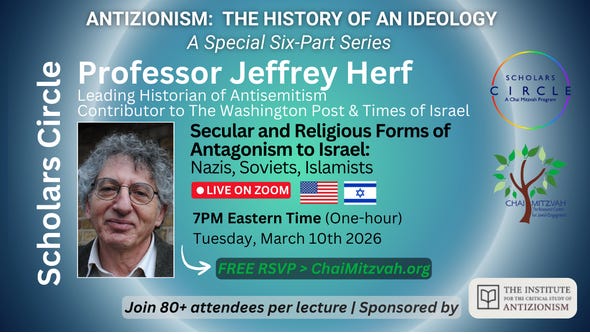
The full schedule of the webinar series is available here.
SEEKING COLLABORATORS
(1) From a Member:
I am working on constructing a Glossary of Antizionism and am looking for collaborators. This project involves tabulating the recurring tropes, libels, quotations, and references that circulate across antizionist texts. The goal is not to refute antizionist claims, but to isolate them as textual fragments and track their circulation across decades, institutions, and archives. For example, one entry might be the “Joshua conquest libel” — the claim that Israelis believe they are commanded to reenact the biblical conquest and commit genocide. A related sub-entry might be the George Tamarin study, which is frequently cited in connection with that accusation. Another entry might track the phrase “Zionist mentality” and document where and how it appears across texts. The ambition of this project is eventually to be comprehensive. With multiple contributors, it should be possible to systematically comb through major antizionist archives — for example, the Palestine Research Center essay series — and map their recurring constructions, along with similar materials across other institutions and periods. I have created a shared Google document. If you believe you could contribute meaningfully, please get in touch (preferably by email). Contributors will be vetted and invited to suggest entries and add citations (last name and date format). This is a long-term project. I do not believe any such research programme has ever been undertaken. By doing this work, antizionism becomes legible and transparent as an object with its own internal structure.
If interested, contact Adam Louis-Klein directly at adamlouisklein@gmail.com.
(2) To create a digital archive of major sources and resources of antizionist scholarship then analysis thereof. Ultimately this archive might be featured on ICSA’s website, or as a self-standing website, but is then foundational to the next part of the project: to use this digitized archive to analyze how antizionist doctrines began, developed, morphed, and spread, including the key libels of colonialism, racism-apartheid, and genocide. (See preceding query.) We must identify and isolate their “tricks of the trade,” such as selective quotation, omission of context, counterevidence, and alternative points of view, the assumption of pure Israeli-Jewish agency and Palestinian passivity, the role that preexisting assumptions about Jewish malevolence play in interpreting events in the ongoing conflict, etc. Once digitized the archive will become available to AI-driven analysis.
(3) Create curricula: A member writes, “I am interested in helping to create a curriculum for educating on this to people who are not as invested. I’ve developed curricula for classes and also feel that I have some insight into what is and what isn’t effective, and what is missing in currently available programs. I think there are at least 2 different courses that could be developed: One would be aimed at Jewish institutions to help them understand how things have changed, and what needs to be addressed in their own work. The other would be aimed at general populations as maybe something like a CE (cont ed) course that would fulfill professional ed requirements.”
CALLS FOR PAPERS, GALORE!
(1) Please consider ICSA your first stop for all your antizionism-related scholarship! This substack (3000+ subscribers and growing) is a vehicle to disseminate your work to an interested audience who may want to use it, build on it, collaborate, etc. Publishing it here first, perhaps in a draft form, could be a good first step toward publication in a proper journal. Please share news of your antizionism-related scholarship here as well, including info about publications, conferences, etc.
(2) Conference: The Association for the Study of the Middle East and Africa (ASMEA) has graciously agreed to provide ICSA some slots for ICSA-related papers and/or a panel at their upcoming conference on November 7 - 9, 2026, in Washington, D.C. To submit a proposal for an ICSA paper or a panel, please both (A) follow ASMEA’s submission procedure AND (B) message me separately that you are doing so. (They ask for an “approximately one-page proposal.”) To submit the proposal: visit this link, create a free account, and follow the prompts: https://www.asmeascholars.org/call-for-papers-2026. ASMEA’s deadline is May 15, 2026. Please let me know by May 1, 2026 if you plan to submit a proposal and/or let me know once you have done so.
Though the details are not yet confirmed, ICSA expects to be able to pay $1000 to each individual whose work is presented under ICSA’s banner.
(3) Journal: ICSA intends to produce the inaugural edition of its journal, Critical Studies of Antizionism, by early fall of 2026. We are creating an editorial board and will institute a peer-review process. The theme will be “Antizionism in Focus” (or perhaps “Antizionism Exposed”). We initially seek papers in three categories in particular, though please share any of your ideas.
(i) Deep critical dives into those academic disciplines most thoroughly captured by antizionism (Middle East Studies, Anthropology, Sociology, Women’s Studies, LGBT, etc). We would like to understand how that capture occurred, the non-academic mechanisms (such as social pressure, and rule-breakings) involved, the ideological aspects that produce such counterintuitive phenomena as “Queers for Palestine,” etc. The goal is not merely to critique but to expose: to show that such capture is not only academically unsound but driven by and producing deeper darker things that should have no place in a university environment.
(ii) Deep critical dives into leading antizionist scholars. We would like papers that don’t merely critique a Rashid Khalidi or Ilan Pappé or Peter Beinart (for example) but expose them: as “unconvincing and hollow” and/or as “repudiating moral and spiritual values,” as well as repudiating academic values by engaging in such dishonest “tricks of the trade” as selective quotation, deliberate omissions of context, circular reasoning (that begins with a hateful presumption about Israel or the Jews then cherry-picks evidence to support it), etc.
(iii) Jewish antizionism. Theoretical work critiquing or exposing the ideology developed by Jewish antizionist scholars (such as “diasporism”), or examining the role the presence of such individuals plays in “Jew-washing” the potential antisemitism of antizionism, etc. Empirical work about (e.g.) the factors that lead individual Jews into antizionism, as well as about how the broader Jewish community should address the problem, etc.
Papers for the journal should be 2000-3000 words. Deadline for submissions is June 15, 2026, but please let us know as soon as you do whether you plan to submit something.
Though the details are not yet confirmed, ICSA expects to be able to pay $1000 to each person whose paper is accepted. Note: the same work could both be presented at the ASMEA conference and appear in the journal, thus earning double compensation.
RESOURCES and CALL TO ACTION
(1) We begin again with the anonymous blogger who does the work of teams of scholars. Elder of Ziyon has uncovered an absolutely dreadfully evil peer-reviewed article in an academic journal, essentially encouraging budding teachers to begin teaching children to hate Jews, as early as preschool.
**CALL TO ACTION**: I believe we need to unleash a storm of public critique of this article, of this journal for publishing it, and of this author. If there are any volunteers to coordinate this, please let me know.
A Peer-Reviewed Blueprint for Teaching Children to Hate Jews
Exploiting the power dynamic against schoolkids
By Elder of Ziyon
A newly published paper in a peer-reviewed academic journal demands that all US educators teach their students to hate Jews as their primary goal.
I am not exaggerating.
Who are these powerful people? The paper is explicit:
“Universities and institutions of higher education are often beholden to local, state, and national politicians, political interests, and funders with certain political interests. Often funders with a great deal of power and influence encourage university administrators to engage in compulsory Zionism by making statements condemning antisemitism whilst ignoring campus-based violence driven by Islamophobia and anti-Palestinian racism...”
Read that again. Jewish donors — “funders with certain political interests” — are secretly controlling university administrators, forcing them to protect Jews from criticism under the guise of fighting antisemitism. This is an antisemitic conspiracy theory published in a peer-reviewed academic paper being disseminated to teacher educators across the United States.
This is the Protocols of the Elders of Zion with a faculty appointment …
=====
(2) Making the rounds in the past couple of weeks is a new report from a group called “For the Sake of Argument” that they produced by “listening” to Jewish antizionists, to better understand their stories and perspectives. Joshua Dabelstein and MAAZ “read the report so you don’t have to.” Here is their take on it:
Report on Young Jewish Antizionists Beggars Belief
By Joshua Dabelstein and the Movement Against Antizionism (MAAZ)
Much like the Jewish Council and the Hindenburg, it is likely that For the Sake of Argument’s February 2026 report, Journeys & Destinations: Young Jewish Anti-Zionists, was born of good intentions.
Damage control now defines the labour of Jewish advocates—damage wrought from outside, and from within. The report probably considers itself to be part of this effort.
Much of this effort now centres on a global failure to discern between anti-Zionism and antizionism. The report seeks to better explain “Anti-Zionist” Jews to the broader community, which it casts as misunderstood and maligned.
Based on conversations with around 30 young American Jews, the authors of Journeys & Destinations hoped to bridge what they describe as a growing schism between “Zionist” and “anti-Zionist” Jews.
Most of my time with the Journeys & Destinations report has gone into working out what they mean by the words they’re using, and whether their use of the word “anti-Zionism” is consistent with its origins and intention.
Without clear definitions, we risk using the same word to describe mutually exclusive positions.
Read the rest here.

=====
(3) And now some empirical work on the relationship between being an antizionist and being an antisemite …..
If You’re Anti-Israel, Are You Antisemitic? Here’s What the Data Says
by Samuel J. Abrams and Steven M. Cohen
For more than a year now — indeed, well before October 7 2023 — American college and university campuses have been saturated with a familiar insistence: We don’t hate Jews. We just oppose Israel.
Since the Oct. 7 Hamas massacre, that claim has grown louder and more strident; but it did not originate there. What October 7 did was strip away any remaining ambiguity, transforming a rhetoric that had long circulated at the margins into something mainstream, unapologetic, and increasingly coercive.
The argument has been well-rehearsed and made nationwide. Protesters insist their calls for Israel’s elimination are purely political, rooted in moral concern for Palestinians, not hostility toward Jews.
To suggest otherwise, they argue, is to conflate critique with bigotry and to weaponize antisemitism as a shield against dissent. Jewish students, meanwhile, describe a very different reality. They experience not policy disagreement but negation: of peoplehood, of legitimacy, of belonging. They are told that the one collective expression of Jewish continuity in the modern world is uniquely immoral; that Jewish self-determination is inherently suspect; that Jews, alone among peoples, must justify their right to exist.
When Jewish students say this feels antisemitic, they are often met not with curiosity but with dismissal. They are told they are confused, hypersensitive, or acting in bad faith. Administrators, eager to avoid controversy, retreat into procedural language, insisting that what is unfolding is political speech — even when it spills into exclusion, intimidation, and collective punishment.
Until recently, this dispute has rested largely on moral intuition and lived experience. Those matter. But they are no longer all we have. New survey evidence now allows us to examine empirically whether the claim at the heart of contemporary campus activism — that opposition to Israel is distinct from hostility toward Jews — actually holds up.
It does not …
Read the rest at https://www.algemeiner.com/2026/02/24/if-youre-anti-israel-are-you-antisemitic-heres-what-the-data-says/
=====
OK, that’s it, for now! Stay tuned for some new work coming in the next couple of days …
And remember:
We need teams of scholars producing reams of scholarship on antizionism.
We need ICSA.
Please be in touch with questions, comments, or to get more involved.
Andrew Pessin