On Jewish Education
Remarks at the Frankel Jewish Academy Annual Gala, 2026

Frankel Jewish Academy
May 14, 2026
Thank you – R. Cohen, the board of Frankel Jewish Academy, Kelly and David, Morah Bosmat (you sound amazing!), and most of all the families and students here tonight – for honoring me with the privilege of addressing you. Thanks especially to Kelly and David, so deservedly honored tonight, superhumans, for initiating the invitation. Kelly, who knew, thirty-five years ago, back in graduate school, when we were sitting around the dark recesses of Columbia University thinking we were just about the only remotely sane and rational people there, surrounded by mostly lunatics and mad-persons, that we would meet here again tonight, in Detroit, thirty five years later? And who knew, back then, how right we were …
We are living in a truly crazy world, especially on our campuses, so many of our campuses.
I begin by going back before graduate school, before college, before high school even. The first draft of my bar mitzvah speech, which (fortunately) was submitted to the Rabbi for vetting, began with the immortal words, “Now that I have completed my Jewish education ….” I remember nothing else from the speech beyond that first phrase, not least because the Rabbi furiously crossed it out in red ink and replaced it with, “Now that I have just begun my Jewish education ….” Who knew back then, too, how wrong I was, and how right he was …
I am not an optimistic person by nature. My glass, my wife likes to say, is two-thirds empty and leaking. But where there is grounds for optimism is in the education of our children of the sort you have here at the Frankel Jewish Academy.
There is the famous passage from the Talmud Tractate Berakhot 64a, providing a homiletical interpretation of a verse from Isaiah (54:1):
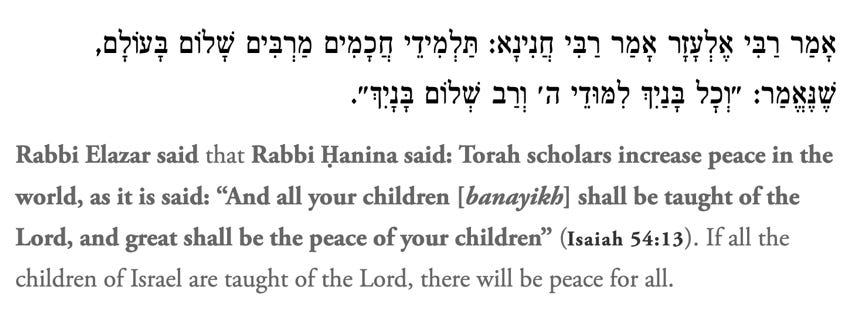

“Rabbi Elazar said that Rabbi Chanina said: Torah scholars increase peace in the world, as it is said: ‘And all your children (banayich) shall be taught of the Lord, and great shall be the peace of your children.’ Do not read ‘your children’ (banayich), but rather ‘your builders’ (bonayikh).“ [1, 2, 3]
Because the Hebrew biblical text was originally unvowelled, the Talmud plays on the similarity between banayich (בניך - your children) and bonayikh (בוניך - your builders) to suggest that the next generation (children) are in fact the builders of the future. There is a trivial sense in which that is true: children are obviously the next generation, so whatever is done in the future, they will be the ones doing it. But it is not at all trivial that for them to become truly “builders”—in the Frankel sense—architects, designers, contractors, and most of all, not merely passive recipients of whatever the world plans to fling their way but active agents both of their own destiny and of the world’s—leaders—then they must receive the proper education. Like a building that requires foundations, but then keeps growing, and expanding.
Like a Jewish education that does not end at age 13, but keeps going.
Among the so many reasons we need schools like Frankel Jewish Academy – we need more of them, and we need more of our people to attend them, and everybody to support them – is that that time must come when we send our children out into the world—into that world which as God’s creation can be so beautiful and so wonderful and so awesome, yet which also can be filled with dark recesses and moral inversions and be less ‘awesome’ than ‘awful.’ For many that first foray into the world will be to a college, and for many of those, those campuses will include too many people, fellow students but also, frighteningly, faculty members, next to whom the lunatics and mad-persons of Columbia University 35 years ago will look like “normals.”
And many of those people, in the grips of various delusional ideologies, will literally hate our children, as they hate us, and our parents, and our religion and our tradition, all under the label of merely hating our “nation-state.”
I don’t mean to frighten you. There is plenty of wonderfulness ahead at college too, and plenty of wonderful people, friends, allies. But we have to send our children to these places with open eyes, prepared for what may come. Being prepared – being educated – is the difference between becoming the passive recipient of whatever other people intend for you, versus being the agent of your own destiny, the master of your own fate.
I imagine most of you are aware, at least generally, of how things have been on too many campuses since the October 7 massacre. But you should know that it did not begin on October 7.
I have been watching – documenting, analyzing, writing about – the campus scene since 2015. It started for me when I was “cancelled” for being, ultimately, I would say, a proud Jew. I was, and am, the only openly Zionist faculty member at my institution. I won’t bore you with the details of my cancellation except to say it was very unpleasant and it was very enormous—I and my family received death threats from around the world—and a scholar wrote a whole book about it because it illustrated a number of important themes that he had been writing about for some time before that. The scholar is Richard Landes, and just a few years ago Landes also published a masterpiece of a book called ‘Can the Whole World Be Wrong?’ Lethal Journalism, Antisemitism, and Global Jihad. I was privileged to write a review of that book, called “The Book That Saw October 7 Coming From a Mile Away.” Everyone must read that book.
My cancellation was very unpleasant, nearly led to a nervous breakdown, and could easily have led me to throw in the towel, stop advocating for Israel, keep my head down, just wait it out until I could retire. There were three reasons I did not go that route, tempting as it was:
First, In addition to the death threats I received hundreds of emails of support, and a change.org petition on my behalf went around the world several times and garnered 10K signatures, leading me to understand that I was not alone, that I had a virtual army behind me, that I was like the tip of a spear being pushed by tens of thousands. The moral of that story is that when you hear of a fellow Jew or Zionist under any form of attack on a campus—and that problem is ongoing—please reach out, send an email, words of encouragement. In my case it was the difference between an emotional collapse and standing up to fight. And what an illustration of the beauty of our community, our tribe.
And the second reason I did not give up: I didn’t stop my Jewish education at my bar-mitzvah. I continued to learn. I was not privileged to go to a Jewish high school, but I kept my interest alive through high school and college, and re-engaged very seriously once out of college. That meant that when they came for me, I was someone who knew a few things. I knew the history of the Jewish people. I knew something about Judaism, Torah, Talmud. I knew the history of Israel, the children of Israel, the ancient states of Israel and Judah, the modern state of Israel. In knowing all that, I therefore knew that I was on the receiving end of a beautiful tradition, that I was part of a truly amazing and beautiful people and community, and that just as these people had endured so much in the past and yet carried on, and were thus an inspiration for me in the present, I had the obligation, to our people, to our history, to our tradition, to our religion, to our God, and even to myself to stand up and fight back. Giving up was not an option, because the children of Israel do not, a child of Israel does not, have “giving up” in his vocabulary, in his toolkit, or in his soul.
And the third reason I persisted: Here is one more thing I knew, from my education.
I have a cartoon that I keep on my office door, as much for myself as for the edification of any who wander by. It is a drawing of an enormous mob of people, and opposite them, standing all alone, is a single isolated person pointing at them and saying, “Yes, you are all wrong.” Pretty clearly it takes incredible courage to be such a person, standing up against a mob—or incredible foolishness, to imagine you are smarter than everyone else, or have the truth when almost everyone else disagrees. Kind of like the other image I have on my office door, for myself as much as for others. It’s a photo taken from a Nazi mass rally, you see an enormous mass of men in a crowd all making the Nazi salute in the same direction, hailing the Fuehrer—and in the middle of that sea of salutes you see a single man sitting there with his arms folded resolutely across his chest, refusing to salute.
I’ve pencilled in the caption below that image: “Be THAT guy!”
The title of Landes’s book captures it: “Can the Whole World be Wrong?” – and we, somehow, apart from the mob, even in isolation, be right?
Indeed, this situation is not at all unfamiliar to Jews, who have a long history of being a very tiny minority standing at odds with the beliefs and practices and values of reigning empires, surrounding neighbors, very nearly “the whole world” around them. It is perhaps the quintessential Jewish condition, going back to Avraham, to Egypt, to the giving of the Torah and all that follows.
In fact one famous Jewish thinker already posed, and grappled with, the question phrased exactly this way. Ahad Ha’am, an early “cultural Zionist,” wrote in 1892 an essay entitled “Some Consolation,” in which he asks, “But, you ask, is it possible that everybody can be wrong, and the Jews right?”
Ahad Ha’am uses the example of the blood libel to defend the yes answer – it is frightening what a large number of people, both historically and to this day, believe that Jews require the blood of gentiles (especially children) for ritual purposes, such as baking into matzah – in fact just this past November a lecturer at the prestigious University College of London openly asserted it -- yet we, we Jews, know that that is false, that we do no such thing, that it is so far from true that one must suspect that the libel is based less on ignorance than on malice.
“Can the Whole World be Wrong?” Landes asks, a hundred and forty years after Ahad Ha’am, deliberately echoing the question.
Yes, the answer goes, and they often are, when it comes to the Jews, and in particular when it comes to the Jewish state.
When the mob, the masses, simply the loudest and most vocal people on your campus, proclaim that you and what you stand for are evil, it would be the easiest thing in the world, the most natural, to capitulate, to break down, to surrender.
But knowing what I knew, having my foundation in Jewish education, allowed me to understand that, indeed—they were all wrong, and I was right – and gave me the fortitude to resist the mob and say, ‘Yes, you are all wrong.’
And they are all wrong.
As I can explain at greater length another time, what is driving the campus situation is an ideology – a set of ideologies to be more precise – that is ultimately as delusional as the blood libel and, one suspects again, that its being so far from the truth suggests again that it is based less in ignorance than in malice. Let’s call that whole set of ideologies “antizionism.” Bigotry, hatred, prejudice come in many forms, and on many levels. You may be surprised to learn that various surveys suggest that antisemitism does not decrease as one acquires more education but tends to increase. Put differently, college graduates on average are more antisemitic than those who don’t go to college, graduate students even more so, and PhD’s the most. You may be familiar with the Wannsee conference in 1942, the famous conference where the Nazis worked out the logistics of murdering millions of people. Eight of the 15 Nazis present there had PhDs. I am not surprised by that result, because it reveals something important: the power of ideology.
Ideologies can deeply affect the way a person perceives the world.
There was a famous experiment back in 1980, sometimes called “The Dartmouth Scar Experiment.” Subjects were told the researchers were examining how people respond to physical deformities. So makeup artists created very realistic, and very repulsive, facial scars on the subjects, who were then led into situations where they were being interviewed for jobs. Afterwards they were asked if they detected any bias, awkwardness, or negative attitudes in the interviewers due to their appearances. Many reported that they had, and gave specific concrete examples.
But here’s the thing. Right before they went into the interviews, the makeup artists did a quick “touch up” of the fake facial scar – in which they in fact removed it entirely. The people reporting the bias in the interviewers, falsely believing they had a repulsive facial scar, invented it entirely.
There are many morals to that story, but one is this: believing something changes what you perceive in the world. Believing you have a disfiguring scar on your face leads you to perceive behaviors that aren’t actually there.
And now to switch to an example on the far other side of the spectrum.
October 7 was a barbaric terrorist atrocity. And yet as it was unfolding, on campuses around the world, there were celebrations, endorsements, and calls for more. One Cornell professor called it “exhilarating.” A Columbia professor, still in those dark recesses, called it “awesome.” Many, reeling in the horror, expressed confusion. How could Ivy League professors use those adjectives to describe something so barbaric, so atrocious, so actually genocidal?
I was not confused.
Ideology. In the grips of the antizionist complex of ideologies, they did not see barbaric terrorist jihadic atrocities but saw “decolonization,” “national liberation,” “justice.”
The cases are so very different, and yet so very the same. Just as those believing they had a scar on their face saw things that weren’t there, so too those in the grip of antizionist ideology saw something which just wasn’t there.
In my view this could and should serve as a litmus test for that ideology. For if your ideology leads you to perceive October 7 as something positive—even IF you were inclined to be supportive of the Palestinian cause—then so much the worse for your ideology.
We know the truth, and the whole world—or large swaths of it—are simply wrong.
What Hamas, Hezbollah, Iran et al do is a military war. But on campuses we are fighting an ideological war, a cognitive war.
And that can only be fought by those who have been properly educated.
By people who know their history, their religion, their tradition, their values—and who therefore can distinguish the true from the false, and thus penetrate the falseness of that ideology the way our ancestors penetrated the falseness of idolatry.
By people who have been built to be builders, in the Frankel sense, leaders—and thus have what it takes to stand up to the mob.
You should know that I have launched the Institute for the Critical Study of Antizionism. It is time to go after that ideology, to dismantle it, to loosen its grip on the minds of too many professors, too many students, to turn off this engine which is driving the production of Jew-hate on our campuses. We already have over 200 scholars on our roster, approaching 4000 followers on substack, and we have launched our initial projects. Please check us out (icsa.substack.com).
We are doing our part, on our end, to bring the truth to the cognitive war on our campuses.
But ultimately it is our children, properly educated, who will be the builders, the builders of peace as the Talmud says, because they are equipped with truth, the truths of tradition, the tools of truth-finding, tools honed by centuries of education that as new situations arise equip one to separate the false from the true.
When our primary enemy on our campuses is ideology, then truth will be our primary weapon.
That is the optimism I see tonight—from the people before me, who understand not merely the importance of education – so phrased, that’s a little banal – but understand that when the world starts to turn against the Jews, that when it does so on the basis of ideologies, that truth will be our primary weapon, for the sake of the Jews, for the sake of the West, for the sake of Hashem.
At this existential moment it is incumbent upon the Jewish community, the global Jewish community, to build our builders, to equip our children with the tools they will need in the world as it is being bequeathed to him. Jewish day schools, Jewish high schools, could not be more essential right now, we need more of them, we need more of us to send our children to them, to support them, this should be a community priority to make them available to everyone. I am thrilled that the Frankel Jewish Academy has answered this call, and may it serve as a beacon to so many others to follow their path.
There is a famous Chinese blessing – or is it a curse? – “May you live in interesting times.” We are living, for better or worse, in very interesting times, and it is a time for which we need “all hands on deck.”
Frankel Jewish Academy has answered the call.
Thank you for the privilege of speaking to you tonight.
The title of Richard Landes's book 'Can the whole world be wrong?' is taken from a question asked incredulously by Kofi Annan of an Israeli politician (I believe) defending Israel against its critics. By his question Kofi Annan revealed that he was also under the impression that the 'whole world' was condemning Israel. - But how is that even possible for a thinking man? How does a loud minority of ideologically intoxicated antizionist Jew haters succeed in giving everyone the impression they speak for the whole world? When 'everyone' includes the majority of people disgusted by their antizionist/anti-Western ideological nonsense? That, I would think, is the real mystery at the heart of antisemitism: not the antisemitism or antizionism of the minority of lunatics (whom you will never cure by all the study of antisemitism or antizionism in the world, as theirs is a passion, not an idea), but the helplessness of the silent majority in putting those lunatics in their place. (And I would add that a similar helplessness plagues Muslims in Western countries, who 25 years after 9/11 have still not found a way to banish the Islamists from their midst.) - I had hoped that 10/7 and the subsequent pro-Palestinian marches by the lunatics would have jolted mainstream politicians especially in Europe into some decisive statements and actions to put an end to this lunacy with the approval of the general public, of which they can be assured. But no, they also must be under the impression that the 'whole world' is condemning Israel and therefore must be right! - I don't think intellectuals can contribute much to overcome this helplessness, as their 'talk' only draws attention and gives more weight to the lunatics. Only politicians making political decisions can reveal the support of the silent majority when standing for election. And the one decision that is long overdue is to stop all aid to the Palestinian 'victims' of their own rejectionism (eventually redirecting it to Israel and let Israel manage the aid where necessary), with the clear message that the 'whole world' expects them to end the war for Muslim supremacy in Palestine they started more than 100 years ago.